Welcome to the Baifeng Home
I am Baifeng Zhang (B. Zhang), a computational biologist with expertise in cancer evolution and the metastatic tumor microenvironment. I am currently a Postdoctoral Fellow in Prof. Linghua Wang’s laboratory at MD Anderson Cancer Center.
I earned my bachelor’s degree in molecular biology from Ningbo University (NBU), where I gained hands-on experience in PCR, primer design, and molecular cloning. During my undergraduate studies, I worked with Dr. Xiaojun Yan to develop a loop-mediated isothermal amplification (LAMP) assay for detecting potentially microcystin-producing Microcystis in aquatic environments. The assay offered greater sensitivity and specificity than conventional PCR, with a simpler workflow suited to field applications. This work led to first- and co-first-author publications in Harmful Algae and Acta Ecologica Sinica.
In 2013, I joined BGI as a Bioinformatics Engineer, working with Dr. Xiangchun Li. I subsequently led several large-scale cancer genomics projects involving whole-genome sequencing, whole-exome sequencing, RNA sequencing, and DNA methylation profiling. These projects included studies of renal cancer (Nature Communications, 2019), ovarian cancer (Gynecologic Oncology, 2020), bladder cancer (Molecular Oncology, 2022), and glioma (iScience, 2022).
In 2018, I joined Dr. Zongli Zheng’s group at Karolinska Institutet as a Research Assistant. There, I contributed to the development of SplitFusion, a clinical-grade gene fusion detection tool with applications in molecular diagnostics and the study of tumor heterogeneity (Patterns, 2025).
I received my PhD in 2024 from the Department of Clinical Oncology, Li Ka Shing Faculty of Medicine, The University of Hong Kong (HKUMed), under the joint supervision of Prof. Xinyuan Guan (academic supervisor) and Prof. Dora Lai-wan Kwong (clinical supervisor).
My current research integrates cancer genomics, single-cell and spatial transcriptomics, and AI-driven pathology to investigate cancer cell heterogeneity, tumor evolutionary trajectories, and interactions between evolving tumors and their surrounding immune microenvironments. Related publications include Hepatoma Research, 2021; Advanced Science, 2023; PNAS, 2023; PNAS, 2024; Nature Communications, 2024; PNAS, 2025; and PNAS, 2026.
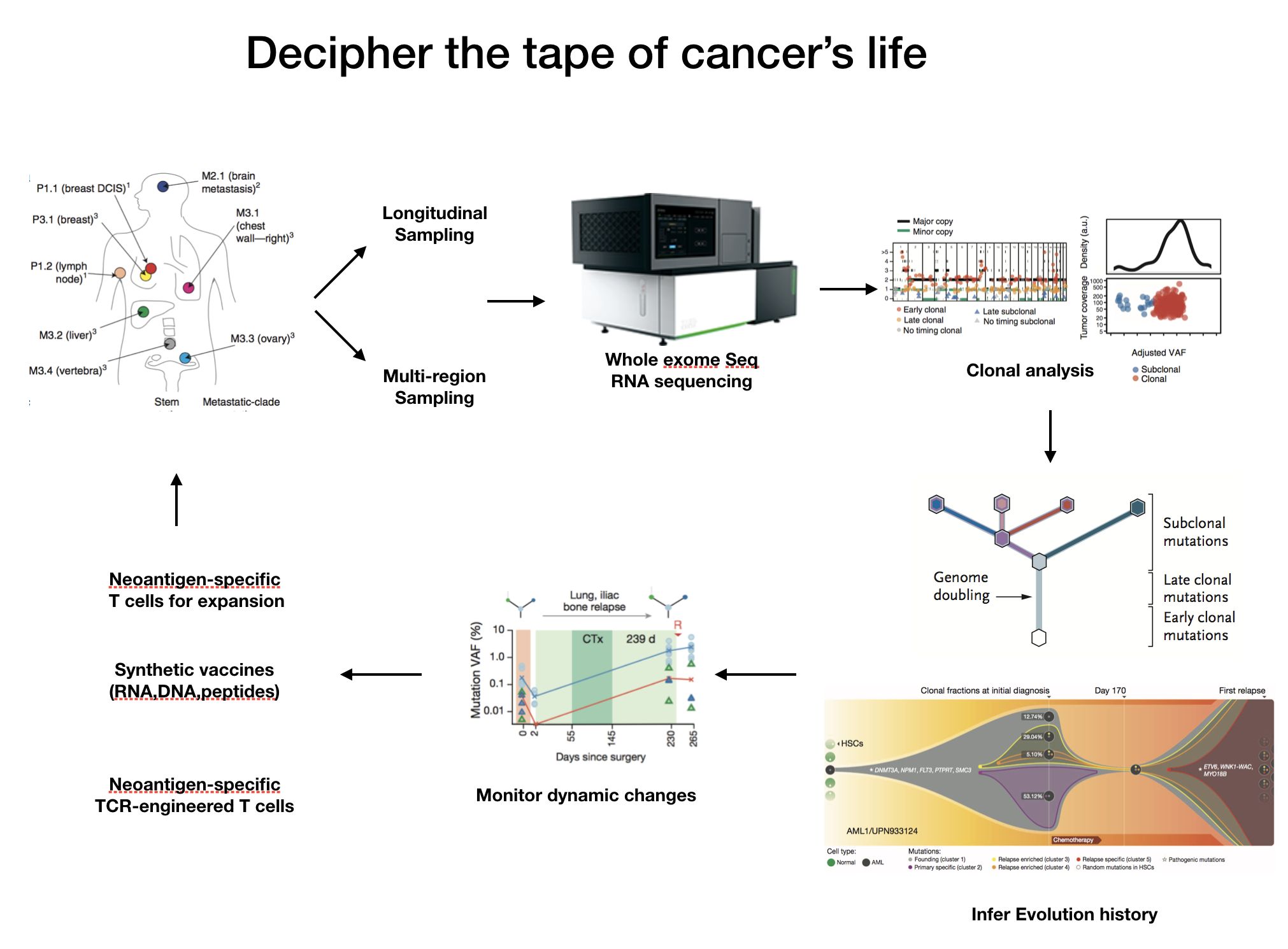


I am focusing on Cancer evolution, Tumor microenvironment, and Foundation model (more info) !


News
13. January 2026Congratulation! Baifeng's the co-first authored paper entitled Multi-omics Identifies a Cholesterol-TFEB-PLD3-TLR9 Axis Driving Immunosuppressive TAMs Polarization in ESCC is published in PNAS!
11. April 2025Congratulation! Baifeng's the co-first authored paper entitled FAO-Fueled OXPHOS and NRF2-Mediated Stress Resilience in MICs Drive Lymph Node Metastasis is published in PNAS!
17. February 2025Congratulations to Dr. Baifeng Zhang on joining MD Anderson Cancer Center as a Postdoctoral Fellow! With a steadfast commitment to a singular goal: Making Cancer History!!
14. February 2025Valentine's Day Gifts! Baifeng's the co-first authored paper entitled SplitFusion enables ultrasensitive gene fusion detection and reveals fusion variant-associated tumor heterogeneity is published in Patterns!
17. November 2024Congratulation! Baifeng's the co-first authored paper entitled GPRC5A promotes lung colonization of esophageal squamous cell carcinoma is published in Nature Communications!
21. October 2024Congratulation! Baifeng's the co-first authored paper entitled QSOX1 facilitates dormant esophageal cancer stem cells to evade immune elimination via PD-L1 upregulation and CD8 T cell exclusion is published in PNAS!
02. August 2024Congratulation to Dr. Baifeng Zhang on his successful PhD denfense!
10. October 2023Congratulation! Baifeng's the co-first authored paper entitled Targeting MFGE8 secreted by cancer-associated fibroblasts blocks angiogenesis and metastasis in esophageal squamous cell carcinoma is published in PNAS!
14-16. June 2023Baifeng is invited to give a short talk on Metastatic microenvironment of ESCC in IAS International Workshop on Biological data science, AI & Medicine (BAM workshop) hosted by HKUST IAS (June 14-16)